

Can You Have Too Much Money in Your RRSP?
Can You Have Too Much Money in Your RRSP?
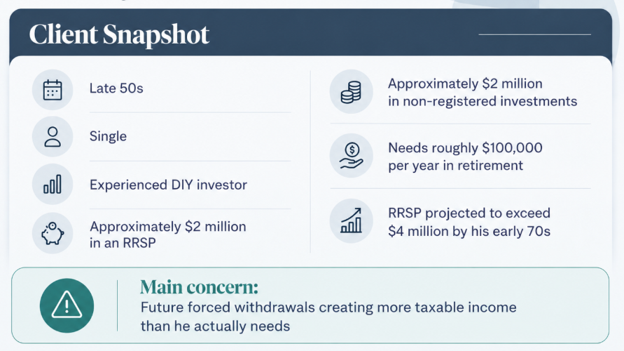
One of our fee-for-service clients is in his late 50s with about $2 million sitting in an RRSP. He also has another $2 million invested outside the RRSP in a non-registered account.
He’s a strong DIY investor and has done very well over the years. After a divorce, he chose to invest his share of the proceeds from the family home instead of buying another property.
It was a smart move that proved to be incredibly lucrative for him. But all that success ultimately created a tax planning problem.
The RRSP Was Growing Faster Than He Could Spend It
At around $2 million today, his RRSP could easily be worth $4 million or more by the time he reaches his early 70s, assuming continued strong returns.
That sounds fantastic. Until taxes enter the chat…
Once an RRSP eventually becomes a RRIF, the government requires you to start taking out a minimum amount of money every year. So as the account gets bigger, the mandatory minimum withdrawal amounts get bigger too.
With a $4 million account, our client could eventually be forced to withdraw somewhere around $220,000 in a year!
Problem is, he doesn’t need $220,000 a year.
He figures roughly $100,000 would give him a very comfortable retirement. CPP and OAS would eventually add even more income.
So he’s basically heading toward a situation where the government could force him to pull considerably more money from his retirement account than he even wants to spend.
And every dollar coming out of that RRSP counts as taxable income. Which, obviously, gets very expensive very quickly.
The Challenge Was Future Forced Withdrawals
While most people are focusing on having enough to retire, this particular client needed to focus on stopping his future taxable income from getting out of hand.
So Zael proposed an RRSP meltdown strategy.
Essentially, you start taking some money out of a very large RRSP earlier instead of leaving the entire account untouched until the government begins forcing larger withdrawals later.
Of course, there’s still tax on those withdrawals, so our planning focused on minimizing the tax bill.
And that’s when debt entered the chat.
Yes, The Strategy Involved An Investment Loan
Our client could borrow money to invest outside his RRSP.
When borrowed money is used for certain qualifying investments, the interest on that loan becomes tax-deductible.
Say our client withdrew $10,000 from the RRSP. That creates $10,000 of taxable income. Now imagine he also had $10,000 of eligible investment loan interest that could be deducted.
Those amounts would largely offset each other for tax purposes.
Meanwhile, some of his wealth is gradually building outside the RRSP, where he has more control over withdrawals and when taxes are triggered.
Over enough time, that could help reduce his future tax burden.
But There Was Still One Slight Problem
His RRSP was growing by roughly $200,000 a year in a strong year. Taking $10,000 out annually was basically bringing a teaspoon to a swimming pool.
To make a serious dent, the strategy would have required much more borrowing.
For example, creating $100,000 a year of interest at a 5% borrowing rate would mean carrying roughly $2 million in investment debt.
That is a very large loan that would make most people nauseated.
Normally, Zael is pretty cautious about using leverage because borrowing magnifies what happens in an investment portfolio, good and bad. Things could go exceptionally well, or they could end in disaster.
So the recommendation was much more modest.
MCO looked at something closer to a $300,000 to $400,000 investment loan.
It wouldn’t completely solve the future RRSP problem. But it would slow it down and give our client more flexibility later.
This Strategy Made Sense For A Very Unusual Client
Just because you have a robust RRSP does not make this an appropriate strategy for you.
Our client was an outlier. He already understood investing and market risk very well. He had millions invested and had successfully managed his own portfolio for years.
And his RRSP was also exceptionally large for the amount of retirement income he needed.
He had enough time before mandatory withdrawals became an issue for MCO to look at ways of managing the problem gradually.
Those very specific reasons are what made this strategy worth exploring.
And Then The Client Chose Not To Do It
After working through the numbers with MCO, the client ultimately decided not to move ahead with the investment loan.
But it was a viable option that deserved to be presented to him. He now understands what his RRSP could look like ten years down the road and the tax implications. He also knows what one possible solution would require.
So he passed, because it meant taking on more debt than he was comfortable with.
The Bigger the RRSP, the More Important the Exit Strategy
Most of you were probably taught to think of an RRSP as a bucket you should keep filling. And for most of you, that advice works perfectly well.
But once you start accumulating serious wealth, your situation gets a lot more complicated.
Someone with a large pension and a substantial RRSP can eventually face the same issue. A high earner who maxed out an RRSP for decades might as well.
Even the timing of RRSP contributions deserves some thought.
If you expect your income to rise significantly later in your career, saving some contribution room for those higher-income years makes the tax deduction considerably more valuable.
This is exactly why retirement planning should happen while retirement is still many years away.
By the time our client reaches his 70s, there will likely be millions of dollars sitting inside an account with government-mandated withdrawals attached to it.
Today, he has lots of time to plan around that.
Our job is to identify the risk early, explain the options clearly, and help you understand the trade-offs. We will never pressure you into a strategy you are not comfortable with.
You make the decision. We make sure it is an informed one.